
米国特許クレームで頻繁に用いられる“configured to”という表現は、翻訳実務において判断に迷うことの多い用語の一つです。
“configured to”には、「~することが可能な」(“capable of”)という意味と、より狭い「~するように構成された」という意味があるとされ、最近のFederal Circuit(米国連邦巡回控訴裁判所、米国知財高裁)の判断では、前者“capable of”が“configured to”の通常の意味(ordinary meaning)であることが確認されました。
In re Blue Buffalo Enterprises, Inc.(Fed. Cir. Jan. 14, 2026)において、出願人であるBuffalo社は、非自明性拒絶に対する反論において、“configured to”は「~するように構成された」という意味のため、「~する」という機能を実現するために何か特別な「構成」が必要である(つまり、“configured to”は“specifically designed to”という意味である)、と主張しています。
これに対し、Federal Circuitは、“configured to”を“capable of”よりも狭く(つまり、“specifically designed to”と)解釈するためには、クレームや実施例においてサポートが必要であるところ、Buffalo社のクレームや実施例にはそのようなサポートがないと反論しています。
また、Federal Circuitは、“adapted to”という表現が“specifically designed to”と解釈されたAspex Eyewear, Inc. v. Mar-chon Eyewear, Inc., 672 F.3d 1335 (Fed. Cir. 2012)について言及し、“adapted to”が“specifically designed to”と同義であるとされた根拠の一つとして、“adapted to”の他に“capable of”という表現も使用されていたことを挙げています。このことから、“adapted to”は“capable of”とは意味が異なることが示唆されている、と述べています。
以上から、Federal Circuitは、本件において“configured to”は“capable of”という通常の意味であると結論付けています。
以上のとおり、“configured to”の解釈は、翻訳者の感覚や語感だけで決められる問題ではないことが改めて確認できますが、この事件から得られる翻訳実務上の気づきをあえてまとめると、以下のようになるかと思われます。
| ・明細書において限定的な解釈を裏付ける記載がない場合、“configured to”は原則として「当該機能を実行できる能力を有する(capable of)」程度に解釈される。 | |
| ・Aspex Eyewear, Inc. v. Marchon Eyewear, Inc.に見られるように、クレーム中で “configured to”と “capable of”が併用されている場合、両者は同義ではなく、異なる意味を持つ用語として解釈される可能性がある。 |
なお、この事件はnonprecedential(非先例)とされているため、いわゆる判例として一般的な基準を示すものではありませんが、Federal Circuitがどのような考え方をとっているかを知る手がかりとして参考になると思われます。
| 代表的なクレーム1: | |
| 1. A packaged food product comprising: | |
| a container including at least one sidewall and a bottom wall which combine to define a storage area, said bottom wall having an integrally formed, tool portion; and | |
| a food product retained within the storage area and in contact with the at least one sidewall, wherein the at least one sidewall is configured to be readily deformable by a hand of a user to reduce a volume of the storage area, and the packaged food product is configured such that reducing the volume of the storage area causes the food product to exit the storage area for further processing with the tool portion. | |
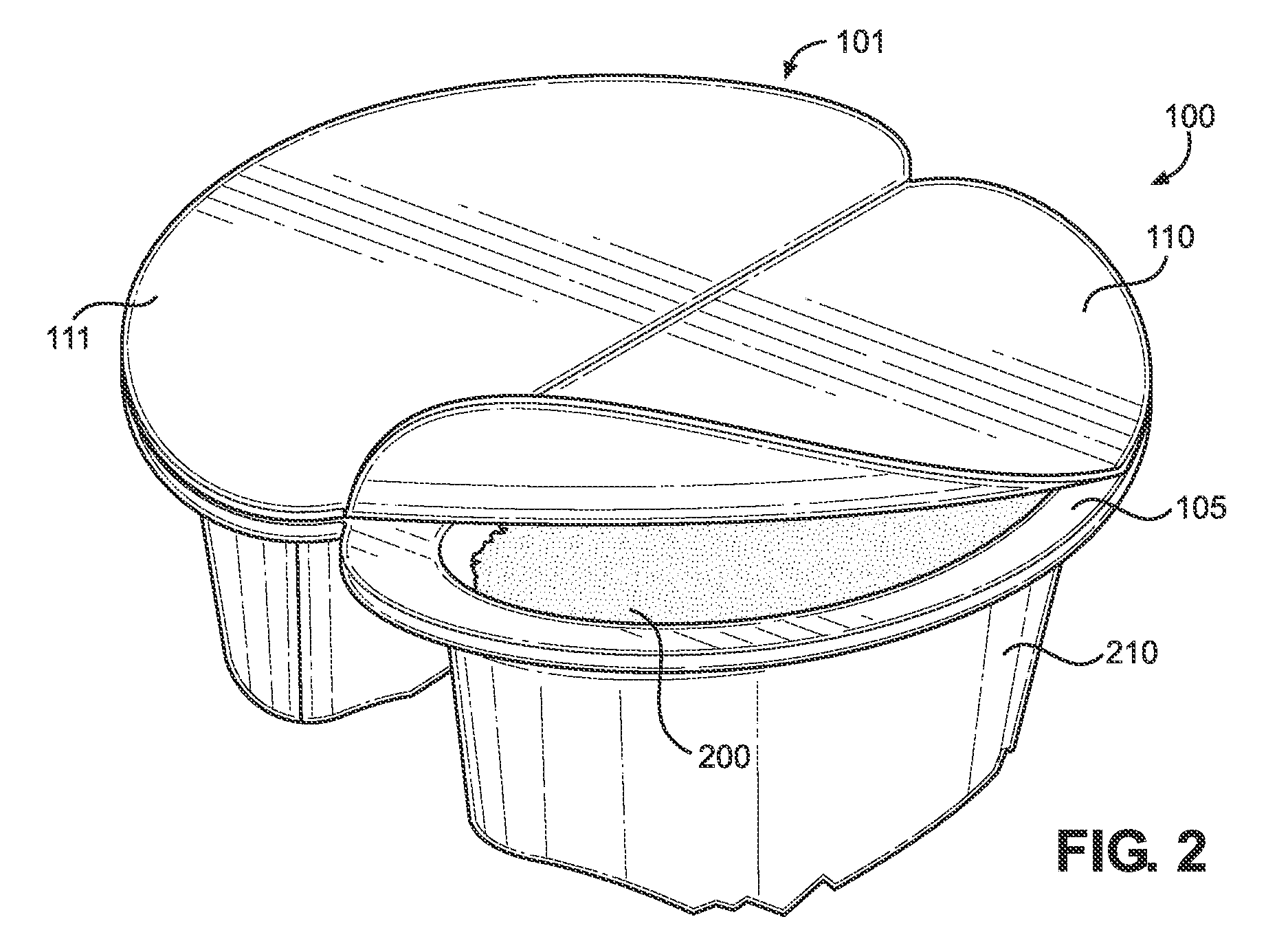
| 代表的な図: | |
 |
| 要約: | |
| A packaged food product (100; 101) includes a container (205) and a food product (200). The container (205) has a rim (105) and at least one sidewall (210) extending from the rim (105) to a bottom wall (300). The at least one sidewall (210) and the bottom wall (300) define a storage area (305), and the food product (200) is retained within the storage area (305) such that the food product (200) is in contact with the at least one sidewall (210). The at least one sidewall (210) is readily deformable by a hand of a user to reduce a volume of the storage area (305). Finger engaging recesses (320, 325) are formed in the bottom wall to assist in deforming the container (205), with reducing the volume of the storage area (305) causing the food product (200) to exit the storage area (305). The bottom wall (300) of the container (205) includes an integral tool portion (330) for breaking up and/or tenderizing the food product (200) after removal from the storage area (305). The food product (200) can be a wet cat or dog food. |
※本記事は一般的な情報提供を目的としたものであり、特定の案件に対する法的助言や翻訳指示を行うものではありません。個別案件については、必ず出願人または代理人と相談の上で対応してください。